Chapter 15 Building Persuasive Arguments

A good persuasive argument should always have a claim. “The claim is the point of your argument; it is the disputed proposition or assertion that you ask your listeners to accept”. The claim is the main idea of the argument. Arguments should have supporting claims and evidence to persuade your listeners. Examples of persuasive claims are:

Stop drinking coffee

Should there be more gun control

Should welfare recipients be required to pass a drug test?

Chapter 14 Persuasive Speaking

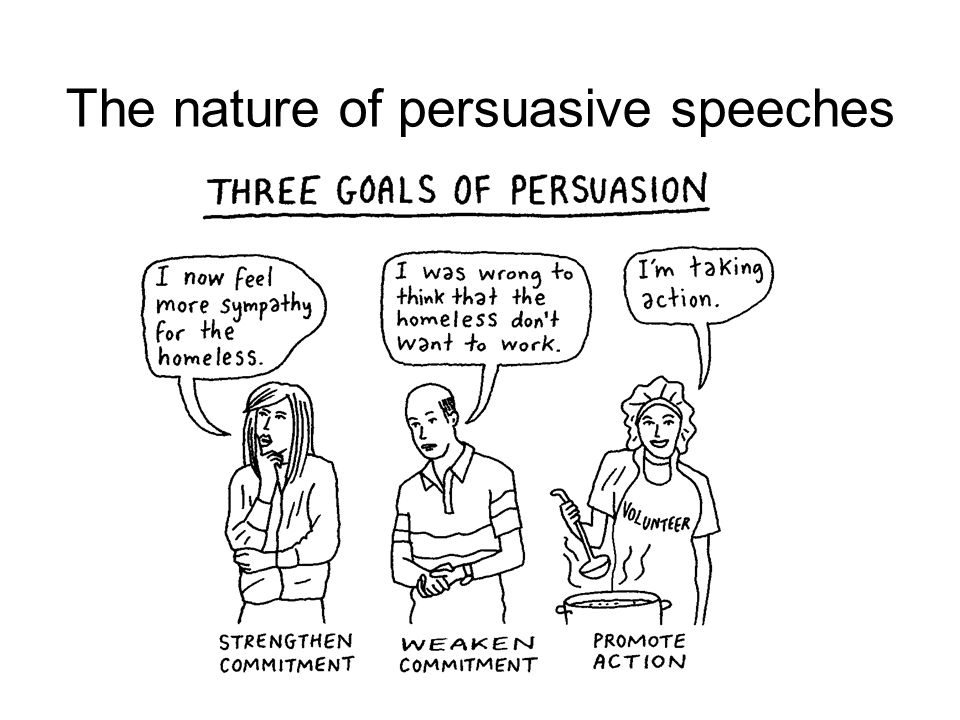
The third stage in the persuasive process is agreement. Agreement is when listeners accept a speaker’s recommendations and remember their reasons for doing so. While listeners are listening to your speech there should be a series of affirmations such as, ” he/ she is right”. ” That’s striking evidence; I didn’t know about that”, ” I believe this plan will work”. You as the speaker must grasp your listeners attention as well as persuade them to be on your side.

slide_3

Chapter 12 Delivering Your Speech

Pitch is the position of the human voice on a scale ranging from low and deep to high and sharp. Singers and public speakers must be aware of their pitch at all times. For effective speaking the speaker must find a pitch level that they are comfortable with. It is important to keep your pitch to a level that they audience can understand what you are saying.Pitch is also important because it can keep the attention of the audience or lose their attention.

images.jpeg

Chapter 11 Putting Words to Work

Doublespeak is a form of speech that is deliberately euphemistic, ambiguous, or obscure language. Doublespeak  are words that point in the direction opposite from the reality they supposedly describe. Leaders doublespeak when they want to mislead their listeners to advance their own agendas.

Some examples of doublespeak are:

  • “Negative cash flow” instead of “broke”
  • “Enhanced interrogation” instead of “torture”
  • “Shabby chic” instead of “old and worn”
  • “A bit shaky” instead of “very poor quality”

Chapter 10 Presentation Aids

Presentation aids are visuals, auditory, and tactile supplements intended to enhance the clarity and effectiveness  of a presentation. Presentation visuals are meant to provide the audience with concrete illustrations  and direct sensory experiences. This method can help the audience grasp the message better. An example of an presentation aid is a powerpoint of charts used to explain budgets at a company meeting. Another example will be the toy a child shows to their classmates when he/she tells the class their show and tell story.

female-with-visual-display

Chapter 13 : Informative Speaking

There are different types of informative speaking. Speech description is a type of informative speaking that uses vivid language to illustrate an activity, object, person, or place. Speeches of description are most effective when they provide concrete and color- full words to create an image of your subject that complements the tone of your message. An example of informative speech description is the way someone describes New York City. New York the City of bright lights, tall buildings, congested streets, never sleeps and diverse in culture and religion. From the theatre at broadway, Fifth Ave shopping center, Greenwich Village bohemian style and much more.


CORT-NYC-StudyUSA07.jpg

Chapter 9 Structuring and Outlining Your Speech

“Categorical design arranges the main ideas of a speech so that they reflect major topics or points of emphasis”. The structure of a speech includes specific purpose, thesis statements and main points. For example :

Specific purpose: To persuade readers that online learning is better than learning in a classroom

Main points 1: benefits  of online learning

2: Statistics on the success of online learning

3. disadvantages of learning in a classroom setting


“Chronological presentations are effective when speakers keep their presentation of events simple, in the order in which they occurred, and related to the specific pur- pose of the speech”.


Chapter 8 Supporting Your Ideas

Disinformation means  information which has been fabricated or distorted in order to advance a hidden agenda. Unless the site is credible you might be reading a lot of disinformation. For example social media ads  like Flat Tummy Tea. All the celebrities advertise this product by giving disinformation to the public. They make it seem like they are taking this tea and the tea is responsible for their weight loss. In fact the company is paying them to advertise their product even if they use the product or not. As stated in the textbook”a general rule, always find more reputable additional sources for incred- ible facts and statistics you find on social media posts and obscure Internet “news” sites”.

disinformation-2082x1171


Chapter 7 Building Responsible Knowledge

“Accidental plagiarism that occurs when we unwittingly misrepresent our sources or present their ideas or words without remembering who said it”. It is important to avoid accidental plagiarism by learning how to cite , research and quote correctly. The textbook explains how to avoid accidental plagiarism by:

  1. Keep careful records throughout your research process.
  2. Consult with your instructor or reference librarian when you are in doubt about how to cite a source.
  3. Take thorough notes that document your sources
    of researched information, and make it a point to distinguish your own ideas and information from those you derive from your sources.
  4. Record quotations accurately, and always cite your sources when quoting or paraphrasing the words of others.

    5. Do not quote or paraphrase others out of context; make sure your use of supporting materials represents the source’s intended meaning.

    6. When in doubt, cite your sources. Your listeners will be impressed and it will enhance your ethos as a speaker.

    7. Run your completed work through an online plagiarism checker such as Turnitin.com. You can probably do this free of charge through your school’s online resources.

    Accidental plagiarism can result in a student failing their course or even being expelled from school.